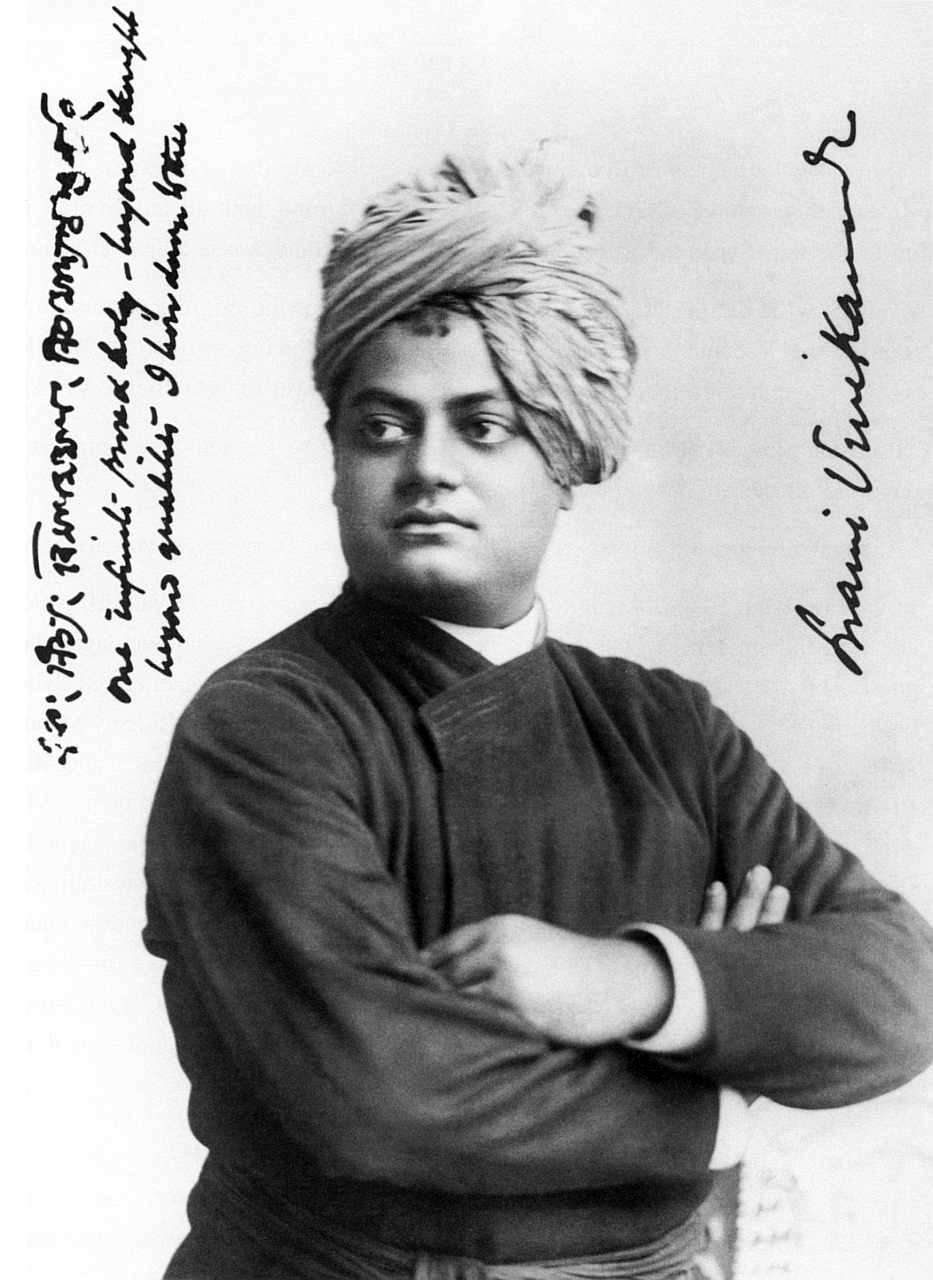
There’s a saying in Chicago: “We don’t want nobody that nobody sent.” This was the cold reception Swami Vivekananda faced when he arrived in the windy city in July 1893, determined to attend the World Parliament of Religions that September. He belonged to no organization, carried no letter of recommendation, his countrymen were nobody, and represented an alien religion to the Western world. As the days passed, his hope of attending the parliament dwindled. With money running out and the odds stacked against him, he left the Windy City and went to Boston, praying for a glimmer of opportunity.
Swamiji came to America to share India’s most profound gift: the wisdom of the Hindu sages, preserved through centuries of oral tradition and embodied by its monks. This was 1893, not 1993—India was under the British grip, its resources drained, and its spirit subdued. Swamiji’s mission was not just a cultural exchange; it was a bold step toward envisioning a future where India could reclaim its identity and progress on its own terms.
As Swamiji delivered lectures on Vedanta and the Bhagavad Gita, he crossed paths with J.H. Wright, a Professor of Greek at Harvard who had studied Sanskrit. Prof. Wright was deeply impressed by Swamiji’s profound knowledge and eloquence. When he learned the Parliament had asked him for a recommendation, the professor declared, “To ask you, Swami, for your credentials is like asking the sun about its right to shine.” Wright added in his letter that Swamiji had learned more than all the Harvard professors combined. Over the next few years, Harvard and Columbia offered professorship to Swamiji, who promptly declined. Prof. Wright's endorsement became a turning point, opening doors for Swamiji to address the Parliament and share India’s spiritual wisdom with the world.
Today, India is known for its exceptional engineers, CEOs, and chess champions. Yet, many wonder how a nation with such immense challenges not only survives but thrives.. In fact, so-called the savior of the West, Winston Churchil opposed Indian independence and never thought Indians could ever manage India, let alone make progress! While the rulers were denigrating all things Indian, Vivekananda had a different vision. The more Indians know and learn about our Indian scriptures and heritage, the more powerful we become.
Swamiji was a Yogi. He studied, meditated, and practiced vedanta. He said “Religion is the manifestation of the Divinity already in man”. In, Hinduism, religion isn’t faith. It’s growth, realization, and manifestation. He offered that to the West. He was among the first to introduce Yoga to the West. Yoga, which means “union” — the union of God and man — is far more expansive than the yogasanas popular in modern gyms. Swamiji emphasized the need for both inner and outer mastery, urging Indian youth to “build muscles of iron and nerves of steel.” His birthday, January 12th, is celebrated as National Youth Day in India.
While ancient India offered many paths to spiritual realization, 19th-century India faced dire challenges of hunger and poverty. Swami Vivekananda captured this stark reality when he said, “Don’t go and preach religion to a hungry man. Feed him first. His religion right now is food.” He understood that science, knowledge, and innovation were crucial for India’s progress. During his journey to Chicago—a two-month voyage through South Asia, Japan, and Canada—he met Jamsetji Nusserwanji Tata, the pioneering industrialist and philanthropist. Tata, like Vivekananda, was deeply troubled by India’s stagnation in science and education. Their conversations, centered on the urgent need for self-reliance and the development of indigenous knowledge systems to break free from colonial dependence.
Swami Vivekananda’s ideas on education, science, and research left a profound impression on Jamsetji Tata. Swamiji spoke passionately about the transformative power of science and education to uplift the masses and restore India’s dignity on the global stage. He believed that India’s deep spiritual heritage could coexist harmoniously with material progress. Encouraging Tata to think boldly, he emphasized how education and research could be harnessed as tools of empowerment, paving the way for India’s self-reliance and resurgence.
Tata was so inspired by Swamiji’s vision that he not only pursued the creation of the Indian Institute of Science (IISc) in Bengaluru but also invited Swamiji to serve as its first leader. Although Swamiji could not accept the role, he and his disciple, Sister Nivedita, enthusiastically supported and promoted Tata’s endeavor. Swamiji wrote this about the project: “The ancient methods of doing things can no longer hold their own against the daily multiplying cunning devices of the modern man. He that will not exercise his brain, to get out the most from Nature, by the least possible expenditure of energy must go to the wall, degenerate, and reach extinction. This is no escape… No idea more potent for good to the whole nation has seen the light of day in modern India.”. Swamiji clearly understood entropy, ROI, and messaging. This sentiment could just as easily have come from Marc Andreessen, the well-known Silicon Valley venture capitalist. Tata and Swamiji were visionary selfless venture investors in India. Over a century later, as we celebrate Swamiji’s 162nd birthday, their investment continues to yield extraordinary returns. Today, the Indian Institute of Science is a premier research university renowned for its cutting-edge scientific and technological research, training scientists for modern India.
In 1893, with the support of Professor J.H. Wright and the generosity of charitable Americans, Swamiji returned to Chicago as a delegate to the Parliament of Religions. He carried a universal message: a call for harmony among humanity’s diverse paths to truth. On the opening day, he stood before an audience of 7,000 and began with the now-immortal words: “Brothers and Sisters of America.” The simplicity, warmth, and universality of his greeting stunned the crowd, which erupted into a thunderous applause that lasted several minutes. Over a century later, you can hear the echoes of that thunderous applause in India and the world.
Comments
Post a Comment